
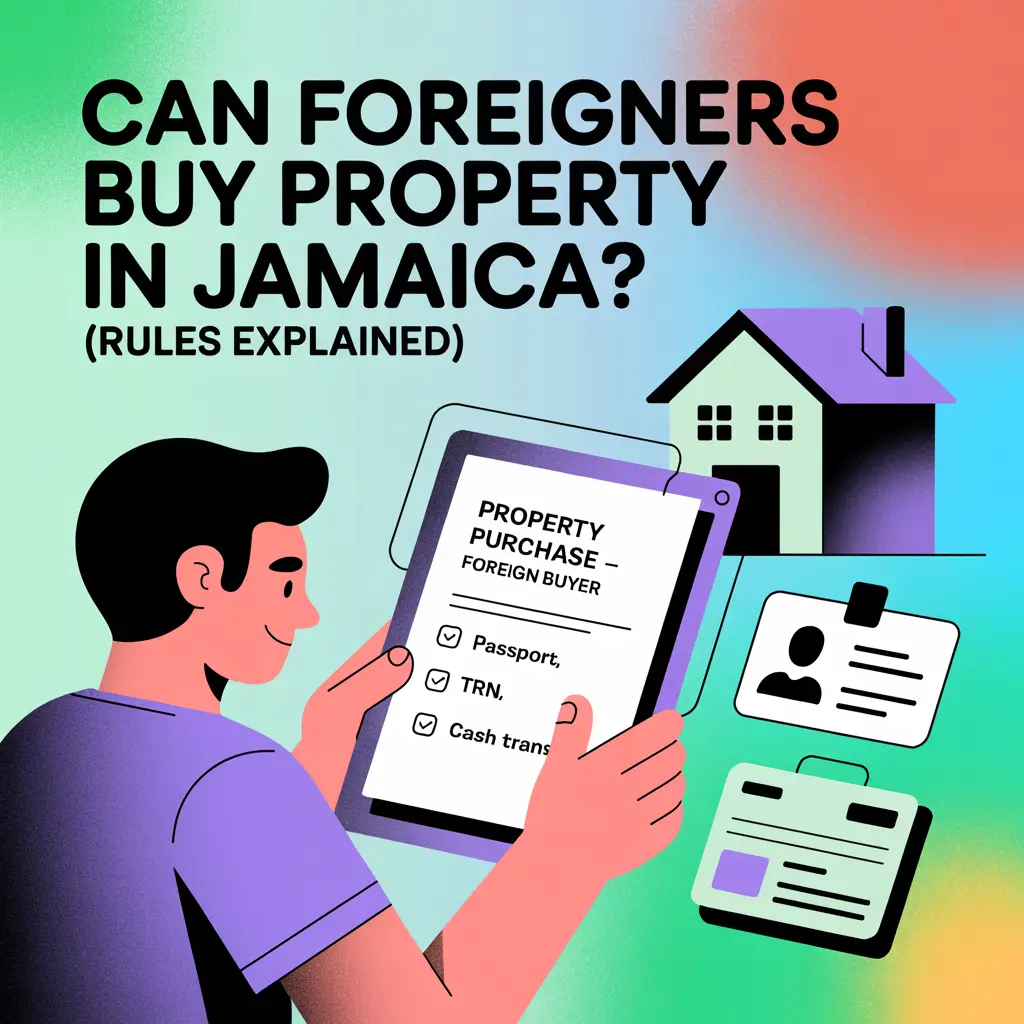
Can Foreigners Buy Property in Jamaica? (Rules Explained)
Short answer: yes, foreigners can buy property in Jamaica.
Jamaica is one of the more foreign-buyer-friendly real estate markets in the Caribbean. Non-citizens are legally allowed to purchase land, houses, apartments, and commercial property without needing special permits, quotas, or local partners. What isn’t allowed is using property ownership as a shortcut to residency, work rights, or citizenship. Foreign buyers must still comply with Jamaica’s tax rules, title registration system, and foreign-exchange regulations, just like any other purchaser operating across borders.
Important disclaimer: owning property in Jamaica does not grant permanent residence, the right to work, or Jamaican citizenship. Immigration status is handled separately through Jamaica’s visa and residency frameworks.
Can Foreigners Legally Buy Property in Jamaica?
No nationality-based ownership restrictions
Jamaica places no legal restrictions based on nationality when it comes to owning real estate. Whether you’re a U.S. citizen, Canadian, British, or from elsewhere, the law treats foreign buyers the same as locals when it comes to property ownership.
Types of property foreigners can buy
Foreigners may legally purchase:
- Residential land and houses
- Condominiums and apartments
- Commercial and investment properties
There are no limits tied to property size, value, or location solely because the buyer is non-Jamaican.
Same ownership rights as Jamaican citizens
Foreign buyers can hold property under freehold title in their own name, through a company, or via a trust, using Jamaica’s national land registration system. In practical terms, this means:
- Your name appears directly on the title
- You enjoy the same legal protections as local owners
- The buying and transfer process follows the same rules
Property ownership does not grant immigration status
This is where many buyers get tripped up. Owning a home in Jamaica does not :
- Automatically qualify you for permanent residency
- Grant work authorization
- Lead to citizenship
If you plan to stay long-term, you must still apply for the appropriate visa or residency status through Jamaica’s immigration authorities.
Basic Legal and Title Rules You Need to Know
Understanding Jamaica’s land and title system is critical, especially for foreign buyers. Most real estate problems don’t come from the property itself, but from how ownership is documented and how carefully title checks are done .
Jamaica’s Land Registration System
Torrens-style system overview
Jamaica operates a Torrens-style land registration system , which means ownership is recorded in a central government registry. Instead of relying solely on chains of old deeds, the system is designed to provide certainty of ownership by showing who legally owns a property at any given time.
In practice, this makes property transfers more secure when the land is properly registered , but it also means buyers must pay close attention to the type of title being sold.
Role of the National Land Agency
The National Land Agency (NLA) manages:
- The island’s land titles registry
- Issuance of Certificates of Title
- Registration of transfers, mortgages, and encumbrances
Any property purchase ultimately passes through the NLA, which is why confirming what appears on the official register is non-negotiable for foreign buyers.
Registered Title vs Common Law Title
Registered Title (Certificate of Title)
A registered title is the strongest and most buyer-friendly form of ownership in Jamaica.
Key advantages:
- Ownership is clearly recorded by the NLA
- Transfers are faster and simpler
- Lower risk of ownership disputes
- Easier to sell, mortgage, or pass on later
Most foreign buyers are advised to prioritize properties with a valid Certificate of Title whenever possible.
Common law (unregistered) title
Common law or unregistered title relies on historical deeds rather than a government-issued certificate.
Key risks:
- Requires extensive title tracing, often going back decades
- Higher legal costs and longer transaction timelines
- Greater risk of boundary disputes or competing claims
This doesn’t mean unregistered land can’t be bought, but it demands deeper due diligence and a highly experienced Jamaican real estate attorney.
How Ownership Appears on the Title
Sole ownership
One individual is listed as the owner. This is the simplest structure and common for single buyers or sole investors.
Joint tenancy vs tenancy-in-common
When more than one person owns property:
- Joint tenancy : owners hold equal shares, and ownership passes automatically to the surviving owner(s) upon death
- Tenancy-in-common : each owner holds a defined share that can be sold or inherited separately
Choosing the wrong structure can create estate and inheritance problems later, especially for foreign owners.
Importance of correct name registration
Your legal name must appear exactly and correctly on the title. Errors, abbreviations, or mismatches with passport names can:
- Delay resale or refinancing
- Cause complications during inheritance or transfer
- Trigger costly corrections later
This is a detail your attorney must verify before closing.
Key Requirements for Foreign Buyers
Buying property in Jamaica as a foreigner is straightforward, but it isn’t informal. There are a few non-negotiable requirements that every overseas buyer must satisfy to complete a lawful purchase.
Tax Registration Number (TRN)
Why a TRN is mandatory
A Tax Registration Number (TRN) is required for any property transaction in Jamaica. Without it, you cannot:
- Be listed as a purchaser on an Agreement for Sale
- Pay stamp duty or property-related taxes
- Register the property in your name
This applies to all buyers , including non-residents and overseas investors.
When you need it in the buying process
You typically need your TRN before or at the time the Agreement for Sale is prepared . Most attorneys will not proceed with stamping or registration unless the buyer’s TRN is already issued.
Role of Tax Administration Jamaica
Tax Administration Jamaica (TAJ) issues TRNs and manages property-related tax records. Foreign buyers can apply:
- In person while visiting Jamaica
- Through a Jamaican attorney or authorized representative
- Hiring a Jamaican Real Estate Attorney
Why it’s strongly recommended
While not legally mandatory, hiring a Jamaican real estate attorney is considered essential, especially for foreign buyers. Local property law, title systems, and tax procedures are highly technical, and mistakes can be expensive or irreversible.
What your attorney handles
A qualified attorney will manage the entire legal side of the transaction, including:
Agreement for Sale
- Drafting or reviewing the contract
- Ensuring payment terms, timelines, and conditions are clearly defined
Title searches and encumbrances
- Verifying legal ownership
- Checking for mortgages, liens, caveats, or disputes
- Confirming property taxes are up to date
Stamping and registration
- Lodging documents for stamp duty
- Registering the transfer at the Titles Office
- Ensuring the new title is issued correctly in your name
For foreign buyers, this legal oversight is what separates a secure investment from a risky one.
Foreign Currency & Exchange Control Rules
Sending funds from overseas
Most foreign buyers remit purchase funds from abroad. These funds are usually sent through a local Jamaican bank or authorized dealer , where they are documented as foreign investment inflows.
Local bank and AML checks
Banks are required to conduct anti–money laundering (AML) and source-of-funds checks. Expect to provide:
- Identification
- Proof of income or investment source
- Purchase documentation
These checks are routine and do not mean there is a problem with your transaction.
When Bank of Jamaica approval may apply
Certain foreign-currency transactions, especially larger or structured transfers, may require notification or consent under Jamaica’s exchange control framework, which is overseen by the Bank of Jamaica. Your attorney and bank typically coordinate this process.
Closing Costs and Taxes for Foreign Buyers in Jamaica
Understanding the true cost of buying property in Jamaica means looking beyond the purchase price. While Jamaica is relatively affordable compared to many international markets, foreign buyers should budget carefully for deposits, taxes, legal fees, and ongoing obligations.
Upfront Costs
Typical 10% deposit
Most property transactions in Jamaica require a deposit of approximately 10% of the agreed purchase price. This is standard practice and signals the buyer’s commitment once an offer is accepted.
When and where deposits are paid
The deposit is usually paid when the Agreement for Sale is signed and is held:
- In the attorney’s client trust account, or
- Through a licensed real estate broker’s escrow arrangement
Funds are not released to the seller until the transaction reaches completion, provided all conditions are met.
Government Taxes
Stamp duty
Stamp duty on property transactions is:
- A fixed amount of JMD 5,000
- Commonly split equally between buyer and seller , unless otherwise agreed
It becomes payable when the Agreement for Sale is submitted for stamping.
Transfer tax
Transfer tax is charged at 2% of the property value or consideration , whichever is higher.
- The vendor is typically responsible for paying this tax
- Buyers should still ensure it is properly settled, as unpaid transfer tax can delay registration and title issuance
Legal and Registration Fees
Typical attorney fees
Buyer-side legal fees generally range between 2% and 3% of the purchase price , depending on:
- Property value
- Title complexity
- Whether the land is registered or unregistered
Registration and administrative costs
Additional costs may include:
- Title registration fees
- Certified copies of documents
- Courier and filing charges
These are usually modest but should still be factored into the budget.
Estimated total transaction costs
Independent estimates suggest that total transaction costs (buyer and seller combined) typically fall around 10–11% of the property value , placing Jamaica in the mid-range globally for real estate transactions.
Ongoing Property Taxes
Annual property tax obligations
Once you own the property, you are required to pay annual property tax , which is assessed by the government based on the property’s unimproved value.
General cost expectations
Property tax in Jamaica is generally considered modest compared to many North American and European jurisdictions, making long-term ownership relatively affordable for foreign buyers.
Step-by-Step: How Foreigners Buy Property in Jamaica
This is the practical, on-the-ground process most foreign buyers follow, from paperwork to getting the title in hand.
Step 1: Obtain Your TRN
Application basics
Before you can legally buy property in Jamaica, you must obtain a Tax Registration Number (TRN) . This number is required for:
- Appearing on the Agreement for Sale
- Paying stamp duty and other taxes
- Registering the property in your name
The TRN is issued by Jamaica’s tax authority and is a prerequisite for almost every step that follows.
Using a representative if overseas
If you’re not physically in Jamaica, a Jamaican attorney or authorized representative can apply for the TRN on your behalf, using certified identification documents. Many foreign buyers handle this step remotely without delays.
Step 2: Choose a Property and Make an Offer
Offer acceptance
Once you identify a property and agree on price and terms with the seller, your offer is formally accepted, usually subject to contract and due diligence.
Agreement for Sale
A Jamaican attorney prepares or reviews the Agreement for Sale , which sets out:
- Purchase price
- Deposit amount
- Completion timeline
- Conditions that must be satisfied before closing
Paying the deposit
At signing, you typically pay a 10% deposit , which is held in a client trust or escrow account until completion.
Step 3: Legal Due Diligence
Title searches
Your attorney conducts official title searches to confirm:
- Legal ownership
- Accuracy of boundaries
- Whether the land is registered or unregistered
Liens, caveats, and encumbrances
Checks are made for:
- Mortgages
- Court orders
- Caveats or claims by third parties
Any unresolved issue must be cleared before the sale can proceed.
Zoning and tax verification
Your lawyer also confirms:
- Proper zoning and planning permissions
- That property taxes are fully paid and up to date
This step protects you from inheriting legal or financial problems.
Step 4: Complete the Purchase
Paying the balance
Once all conditions are satisfied, you pay the remaining balance of the purchase price, often through a local Jamaican bank.
Stamping and lodging documents
Transfer documents are stamped for tax purposes and officially lodged at the Titles Office through the National Land Agency .
Issuance of new Certificate of Title
After registration, a new Certificate of Title is issued in your name (or company/trust name), confirming you as the legal owner.
Step 5: Post-Purchase Setup
Utilities
With proof of ownership, you can set up or transfer utilities such as electricity, water, and internet into your name.
Property tax registration
You must ensure the property is correctly registered for annual property tax , which continues for as long as you own the property.
Record-keeping for foreign owners
Foreign buyers should securely retain:
- The Certificate of Title
- Stamped transfer documents
- Tax receipts and legal correspondence
These records are essential for resale, inheritance planning, or future financing.
Common Questions Foreign Buyers Ask (FAQ Section)
Do foreigners pay higher property taxes in Jamaica?
No. Foreigners do not pay higher property taxes simply because they are non-Jamaican. Property tax is assessed based on the unimproved value of the land , not the nationality or residency status of the owner. Rates apply equally to locals and foreign owners.
Can a non-resident get a Jamaican mortgage?
Yes, but options are limited. Some Jamaican banks offer mortgages to non-residents, often with:
- Higher down payments
- More stringent income and credit requirements
- Shorter loan terms
Many foreign buyers choose to pay cash or finance through overseas lenders instead.
Can I buy property through a company or trust?
Yes. Foreign buyers can purchase property:
- In their personal name
- Through a locally registered or overseas company
- Via a trust structure
Each option has different tax, estate-planning, and compliance implications, so legal advice is essential before choosing a structure.
Is buying off-plan safe for foreigners?
It can be, but only with proper safeguards. Off-plan purchases should involve:
- Reputable developers
- Clear construction timelines
- Escrow arrangements for deposits
- Strong contractual protections
Foreign buyers should never commit to off-plan deals without experienced legal representation.
What are the biggest mistakes foreign buyers make?
Common pitfalls include:
- Skipping professional legal advice
- Buying unregistered land without understanding the risks
- Assuming ownership grants residency rights
- Underestimating taxes, fees, and closing costs
- Relying solely on verbal assurances instead of documented facts
Key Takeaways for Foreign Buyers
- Jamaica is foreign-buyer friendly: There are no nationality-based restrictions on property ownership.
- The legal process is clear but documentation-heavy: Titles, taxes, and registration must be handled correctly.
- Professional guidance is essential: A qualified Jamaican attorney is not optional, it’s protection.
- Property ownership is an investment, not a visa: Immigration status is separate from real estate ownership.
Final Note
Buying property in Jamaica can be a rewarding investment, but only when it’s done correctly and deliberately . Foreign buyers should always consult qualified Jamaican attorneys, tax professionals, and licensed real estate practitioners before committing funds.
If you’re exploring your options, you can browse listings, buyer guides, and local insights on Yaadroom , built to help buyers understand the market before they sign anything.
News insight
 Feb 12, 2025
How to Find Properties for Sale in Jamaica: A Complete Guide
Looking to buy property in Jamaica? This guide explores the best ways to find homes, land, and comme...
 Feb 11, 2025
Dreaming of a Home in Jamaica? Here’s What You Can Afford
Wondering what you can afford in Jamaica’s 2025 housing market? Explore price ranges, tips, and reso...
 Dec 06, 2024
Buying Your First Home in Jamaica? Read This Before You Start
Buying your first home in Jamaica? Learn the step by step process, key tips, and important costs to...